T is for Timing
“The ABC’s of the Tao of Forex” series
时 — "Timing, the Right Moment"
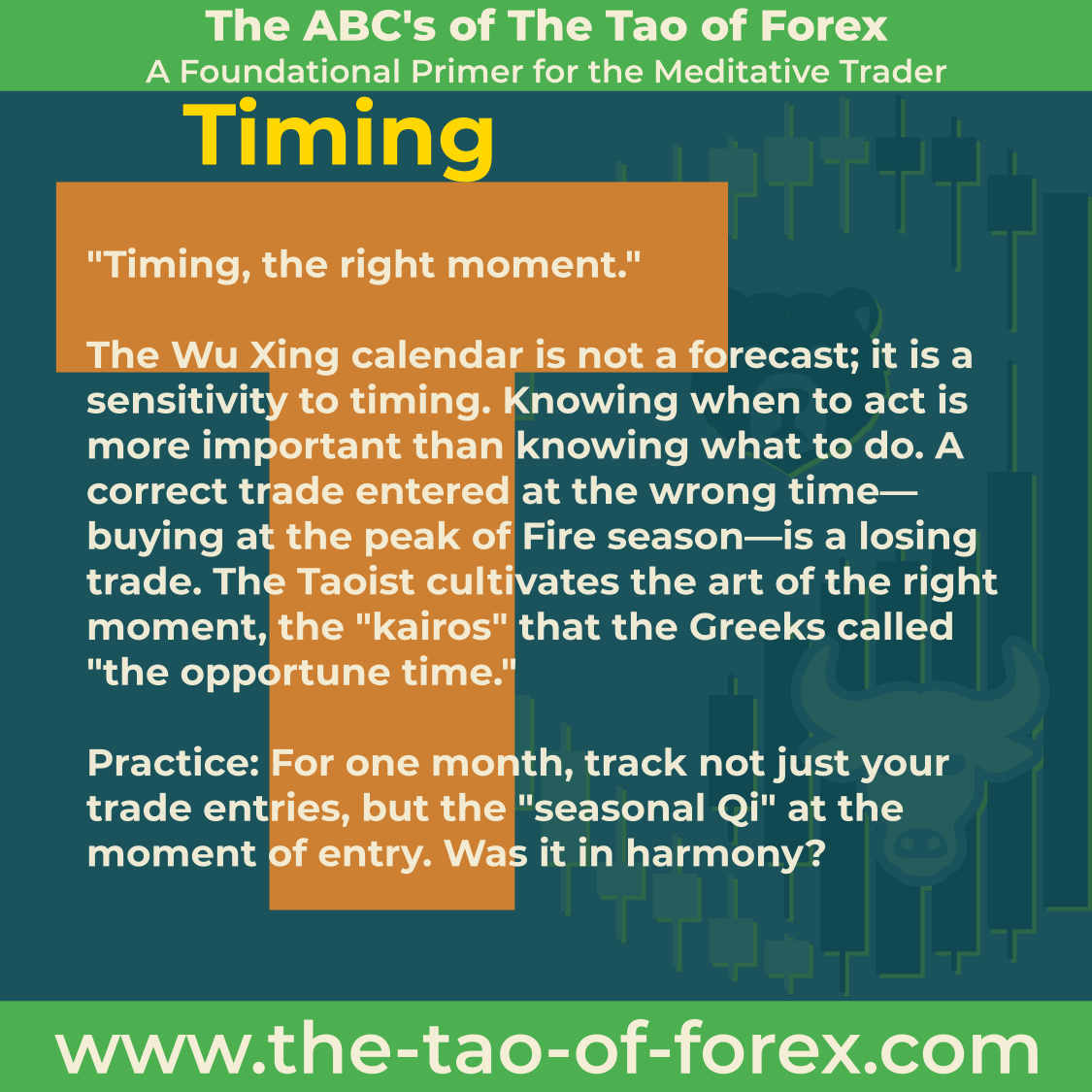
A correct action at the wrong time is a losing action.
时 (Shí) means "time," "season," or "the right moment." In Chinese thought, timing is not an abstract concept but a tangible quality of the present moment. Each moment has a character, an energy, a rightness for certain actions and a wrongness for others.
The I Ching is, at its core, a book about timing. Each hexagram describes not just a situation, but a phase of time. The wisdom is in knowing what kind of time it is, and what kind of action (or non-action) that time calls for.
The Taoist Principle
The farmer does not plant in winter. The farmer does not harvest in spring. The farmer's skill is not in knowing how to plant—anyone can learn that—but in knowing when to plant. Timing is the difference between abundance and famine.
The Taoist cultivates a sensitivity to timing. This is not prediction. It is the ability to read the quality of the present moment and act in harmony with it. It is the difference between pushing a door that opens toward you and pulling a door that opens away. Force against timing is wasted effort. Action aligned with timing is Wu Wei.
The Trading Application
Timing in trading is everything. A brilliant trade idea entered too early is a loss. A mediocre trade idea entered at the perfect moment is a profit. The market does not reward being "right" in the abstract. It rewards being right at the right time.
The Tao of Forex provides two primary tools for cultivating timing sensitivity:
1. The Wu Xing Seasonal Cycle: Is the market in Wood (early trend, entry favored), Fire (trending strongly, hold or add), Earth (harvest, take profits), Metal (contraction, tighten stops), or Water (deep fear, wait for Return)? Trading against the season is fighting the timing.
2. The Six Lines of a Hexagram: Is the trend at Line 2 (emerging, enter), Line 4 (breaking out, enter), or Line 6 (overextended, exit/avoid)? The correct entry at Line 6 is still a bad trade.
Timing also applies to the trader's personal cycle. There are times when you are sharp, rested, and clear. Trade during these times. There are times when you are tired, emotional, or distracted. Do not trade during these times. The Tao does not ask you to be a machine. It asks you to know your own seasons.
The Daily Practice
At the start of your session, after your stillness practice, ask yourself three timing questions:
1. What Wu Xing season is the market in right now?
2. What line of the hexagram is my potential setup at?
3. What season am I in? Am I rested and clear, or tired and forcing?
Answer honestly. Let the answers determine whether and how you trade.
Closing Mantra
"I do not force the season. I wait for the right moment, and then I act without hesitation."
This is one letter of the ABCs of The Tao of Forex—a 26-part journey through the ancient principles that transform trading from a struggle into a practice. Each letter stands alone, but together they form a complete path: from Alignment to Zenith.
If this resonated with you, save it. Sit with it. Let it find its way into your next session, your next trade, your next moment of stillness before the charts. The Dao does not rush, and neither should you.
Ready for the next letter?
© 2026 The Tao of Forex
